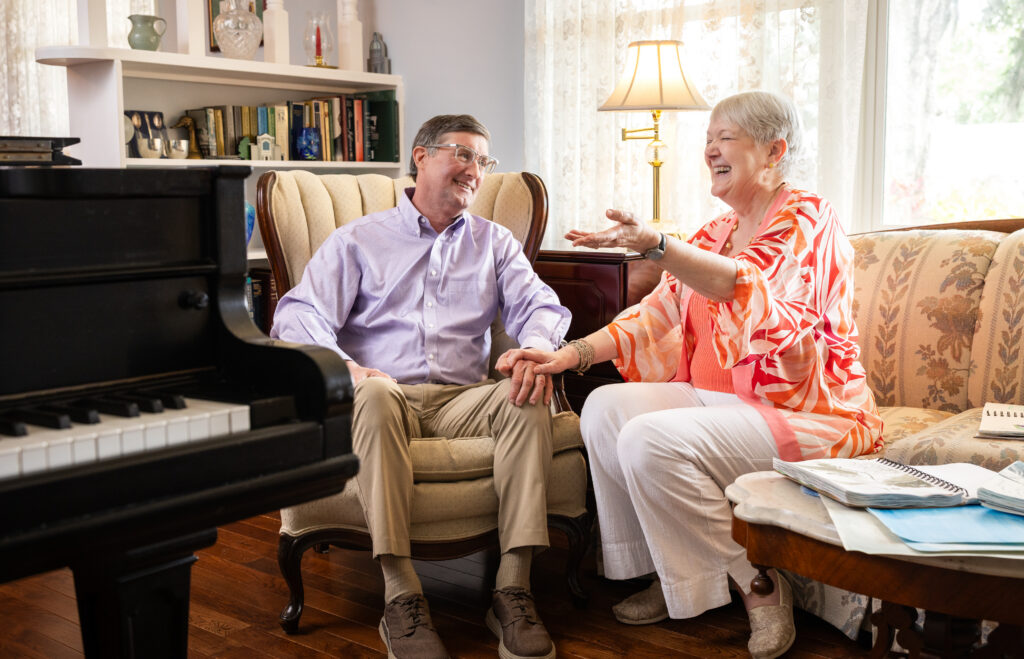
Jeff and Lee Ann Clements | Photo by Laura Evans
A tip about a good piano story brought Calder Yates, CAP’s Grants and Proposals Manager, to the door of retired Jacksonville University marine biology professor Dr. Lee Ann Clements and her husband Jeff Clements, retired chief of research for the Jacksonville City Council’s research division, to hear it himself.
He also talked with the longtime CAP supporters about the similarities they see between the arts and science and the importance of collaboration between disciplines.
 Q: So tell me the piano story!
Jeff Clements: We got married in the summer of 1982. I was working for the county government in Columbia, South Carolina, at that point. The woman that I worked for at the county was moving and wanted to sell a piano. I wanted to buy Lee Ann a piano for our first Christmas, and she was willing to sell it to me for like, $50 a month for a couple of years. And so I bought it on a very extended payment plan. Her Christmas present was a little box with a piece of paper in it that had a little rhyme, and then she had to figure out what that meant.
Lee Ann Clements: I was completely oblivious. Everyone else in the room got it well before I did. It was something like “88 of these.” It said, “If you had all of these, you could open many doors.” So it was clearly 88 keys. I got that — I did not connect it to a piano, because a piano was the furthest thing from my mind. It’s like, “You people got me 88 keys? Why did you get me 88? I don’t understand.”
JC: For context, we were living on hot dogs and mac and cheese. So that was our first Christmas.
Q: Lee Ann, how do you see creativity playing a role in scientific work?
LAC: I think that a lot of non-science folks often have a perception of science as being something you learn, something you do, but that it’s very regimented and without creativity. There is nothing further from the truth. … The process of doing science, of designing experiments, of discovering things, is problem solving and it is creative — particularly when you’re at the level of getting a PhD. That means nobody’s done it before you. You can’t just go to the catalog or to the book and find the experiment that you want to do and follow the directions.
Q: So what does that look like in practice, especially at the research level?
LAC: When I went to graduate school, I had this question I wanted to answer. The bottom line was, how do you figure out how to approach the question? Nobody makes the equipment to do this. It’s not like I could go to Fisher Scientific and buy the “analyze stomach contents” kit. No, I had to figure this out. So what do you use? How do you approach this? It’s the same in the PhD process — how do you approach this? How do you use a different piece of equipment differently than people are already applying it to help you answer your question?
I think of science and the process of doing science as a very creative endeavor, but I understand that non scientists don’t always look at it that way. I love it. I helped design and build aquaria tanks that provided unidirectional flow, so I could test something about how these marine organisms lived in a flowing environment.
And pure science is not always about applying it. Sometimes it’s just about discovery. I look at the process of experimentation in the laboratory — and by the way, they don’t always work the first time, science experiments. They call it research because you always have to redo it. And it’s much like the process of painting or sculpting, which is an experimental process as well. Labs are studios. Studios are labs.
Q: You’ve mentioned before that collaboration between disciplines can be both challenging and rewarding. Can you share an example of that from your experience at Jacksonville University?
LAC: Jeff and I sang in the Choral Union and we did a concert with the dance program at JU. The chorus provided the live music for the dancers. We had a week of rehearsals where we were trying to put it together. Some of their choreography just didn’t work with 25 extra bodies on the stage, and we couldn’t move around in the same way they did. We’re holding music, you know, and we’ve got to look at what we’re doing. So we can’t be looking out for you guys, we can’t be dancing while we’re trying to sing this!
I was not sure it was going to come together. The first two days of those rehearsals, I thought, “Oh, this is a dumpster fire.”
JC: We finally got it all put together. In the end, it was a beautiful joint production. There were instrumental musicians as well.
By the end of the last rehearsal, when we were going into performance the next day, the faculty from the three groups got together, and the stage manager and all, and they sort of gave us a little pep talk, you know, “Everybody’s working so hard, and we’re ready to go. I think we finally got it all put together.” And the director of the dance program was talking about what an amazing collaboration this was. He said, “You know, we talk about doing this in the department, the dancers and the singers together, but we don’t often do it.” He got choked up—little tears were forming. That’s what art can do for you.
CAP’s arts integration programs combine arts education with academic subjects such as science, math and English. This approach leads to better test scores, better attendance and more. Click here to learn more about arts integration.