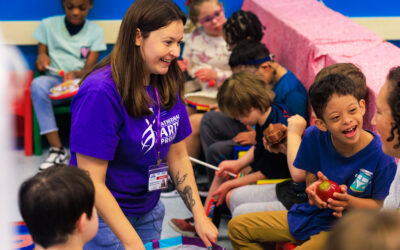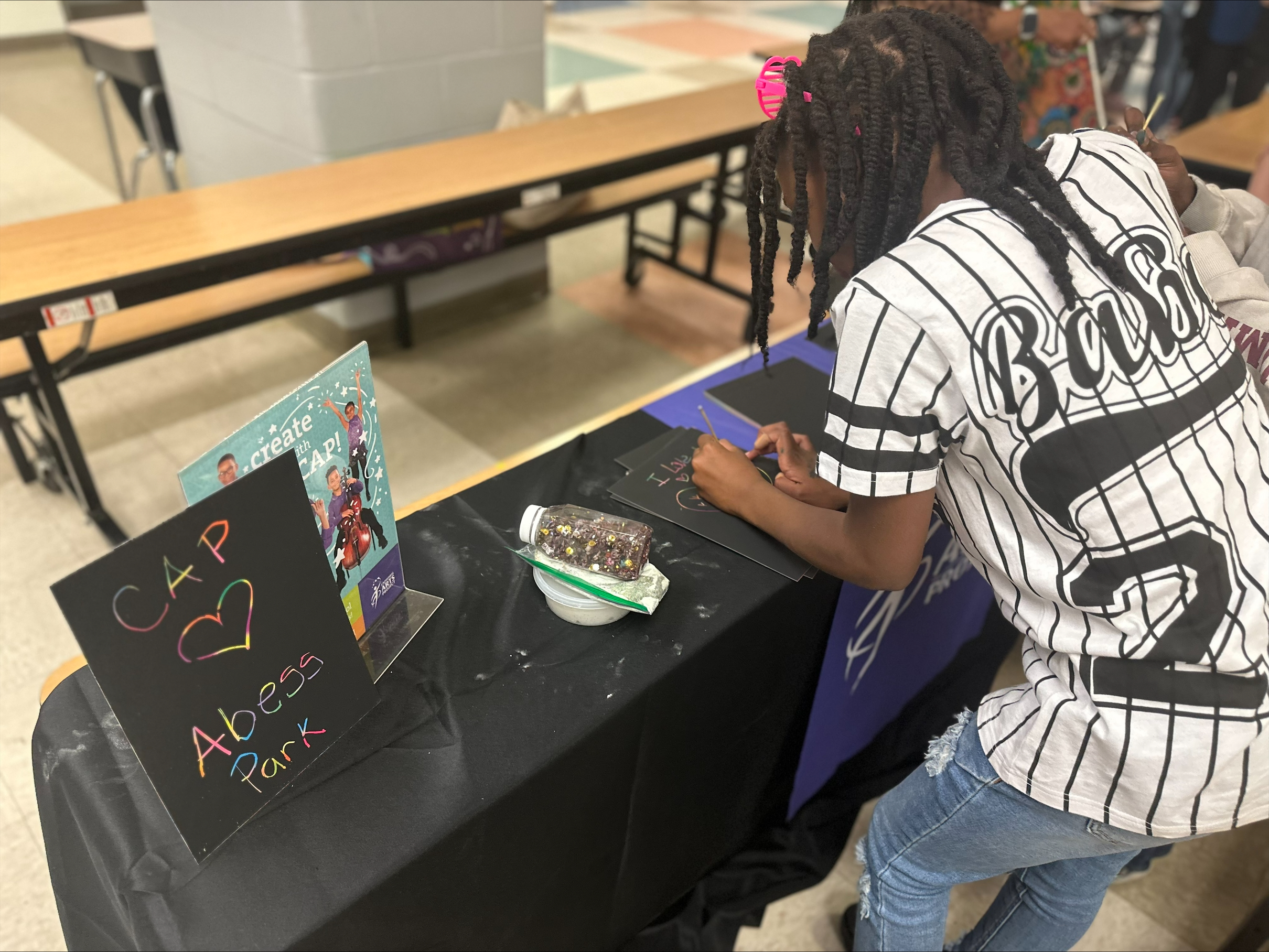
Students make scratch-off art during an Arts Integration Night at Abess Park
For three years, CAP has partnered with Abess Park Elementary School to provide its third graders with theatre instruction to enhance their English Language Arts (ELA) curriculum. This approach, called arts integration, has produced phenomenal results, providing strong evidence that arts integration helps pave the road to success.
What is Arts Integration?
CAP’s arts integration programs, which we call Art Smarts, integrate the arts with learning, offering a unique approach to increasing students’ understanding of academic standards. In an arts-integrated curriculum, an art form—whether dance, music, theatre or the visual arts—is used as a tool for learning one or more academic subjects.
The method provides students with new ways to learn and retain lessons, and classroom teachers with techniques that can be recreated and used in the future.
CAP Arts Integration Students’ Test Scores Soar Above State and District Averages
We analyzed results across several metrics over the three-year period. At the end of the 24-25 school year, our third year of partnership with Abess Park:
• Arts integration student proficiency on the Florida Assessment of Student Thinking, or FAST, ELA test at Abess Park increased from a pre-CAP baseline of 51% in 2022 to 67%. (The FAST includes VPK–10th grade ELA reading and VPK–8th grade math assessments, and is administered three times per year to monitor student growth over time.) That’s an increase of 16 percentage points!
• The Abess Park program consistently outperformed district and state averages in academic achievement. Students started the 24-25 year 17 percentage points above the district average and 15 above the same Florida-wide statistic. By the end of the year, scores stayed high at 16 and 10 points ahead, respectively.
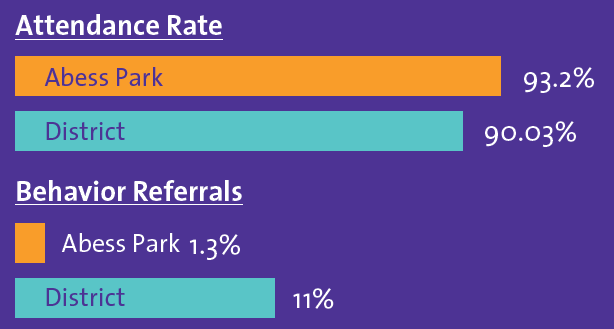
• Attendance among CAP students at Abess was about 3 percentage points higher than the district average. As CAP Vice President of Advocacy and Community Engagement Lucy Chen recently wrote, “[c]hronic absenteeism is a longstanding problem… Recent data show that in 20 states, more than 30% of students are chronically absent, about twice the rate seen before the pandemic.”
• Only 1.3% of CAP’s Abess Park students received one or more behavior referrals, a process used in schools and organizations to report an individual’s concerning, disruptive, or harmful actions for intervention. The school district average is 11%.
“I deeply value this partnership and the positive impact it continues to make in enriching our students’ educational experience at Abess Park,” said Dr. Sabrina Session-Jones, principal at Abess Park. “Intentionally acknowledging the whole child has created an environment where students can express themselves and thrive in and beyond the classroom.”
Visit our Arts Integration page to learn more about how to bring this kind of program to your educational site.