When she was in middle school, Jackie Peterson had never auditioned for anything. She just knew what she liked to do—dance—and she went for it.
“I had never been taught technique in my life. I was watching MTV, copying the movements,” she recalls. “When I tried out for Douglas Anderson School of the Arts, it was a bet. Two friends and I bet each other to try out. We both got in.”
At Douglas Anderson, Jackie found more than a dance program. She found a way to improve her emotional well-being. “They gave me a chance. And when I stepped into that classroom, it changed my life,” she says. “I fell in love with ballet—the structure of ballet. Some people think it’s too hard, but it just calmed me down. I was an angry teenager.”
Today, she is CAP’s Teaching Artist Fellow in Dance, leading the CAP Dance Ensemble and teaching dance at several area schools.
The Mental and Physical Benefits of “Going for It”—Whatever “It” Is For You

Jackie in rehearsal with her CAP Dance Ensemble students
The act of dancing, singing or otherwise creating art isn’t just about improving a technique or becoming a professional artist. It can improve your mental health and teach you other important skills.
According to the Mayo Clinic, “the arts also can be beneficial to your physical and mental health when you experience them—as an appreciator or creator. For example, creating visual art like drawings or paintings can provide enjoyment and distraction from things like pain and anxiety. Listening to music might help to improve blood pressure and sleep quality, and can help keep you calm and relaxed during a medical procedure.”
CAP’s own research supports these findings. Middle school-age students who participated in CAP’s art counseling programming last year reported they had gained increased ability to submit homework and classwork on time; confidence in their ability to manage conflict with peers; and decreased feelings of anxiety and overwhelm.
So when Jackie says that dance saved her life, she isn’t joking around.
But how does one channel her “just go for it” energy and fully enjoy the benefits of creating art? Here’s her advice.
Step one: Listen to your body.
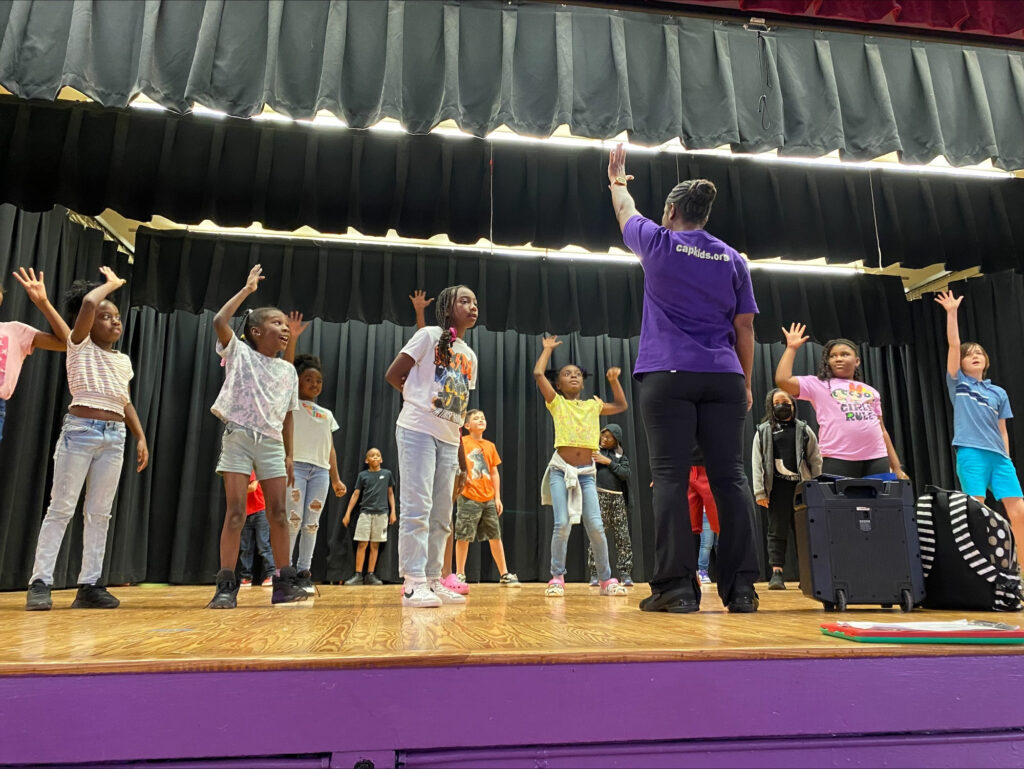
Jacking leading students in a dance-and-math arts integration class at Ruth Upson Elementary
Start simple and pay attention to what activities you naturally gravitate toward when you’re feeling completely yourself. Do you love to sing loudly in the car or dance like no one’s watching? Do you find yourself doodling in the margins of your notebook? Have you secretly dreamed of auditioning for a local theatre production?
“Find out what art genre you love,” Jackie says. “If it is dance, that would be wonderful. But it could be drama, visual arts, graphic arts.”
Whatever it is, it should be something that gives you the feeling you’re looking for—whether that’s calmness, invigoration or happiness. It’s okay if you feel like you’re bad at it! You’re doing it for yourself, all alone. It doesn’t have to become your job or make you any money. It’s about letting go and letting in the joy of creating art.
Step two: Make time for it.
Without a consistent effort, your art may not yield the long-lasting results you want. Jackie recalls a story from her early years at DA that illustrates this point. “One day we were practicing and the music stopped. It was because of me! I kept messing up,” she laughs. “I told myself, ‘I’m going to take my movements home and I’m going to practice, so I will not be the one again.’ It’s just putting the energy into it. That really strengthened me.”
That experience taught her valuable skills that have stayed with her for life: Resilience and dedication.
“Now, if there’s something I have to do that’s hard, I’m going to take it, work on it and come back to the table,” Jackie says. “Make it a part of your schedule, even if it is once a week or once a day.”
Step three: Be present.
“Put your whole body into it,” she says. Forget feeling awkward or unsure of the steps. “Know that you are doing it for yourself.”
Of course, this can be easier said than done. For example, dance students just starting out can often feel embarrassed to do a movement completely—they’ll put their arms up halfway, avoiding fully letting go. But self-consciousness holds us back from fully immersing in our art.
“When we learn dance, we mark the movements. My students, at first, they won’t do it full out, but I tell them, ‘You are dancing for you. This is not for anybody else,'” Jackie says. “It’s for your mental status, your physical exercise. If it’s something you love, you can’t care how everybody else feels about it.”
Being present is also part of learning resilience, and it can take time to develop. “It’s hard for children to get over, it takes practice. It takes somebody encouraging them,” she says. “I’ll say, ‘It’s just me and you, don’t worry about everybody else.’ After a while they’ll pick it up and do it on their own. It takes a couple months, but they start to realize, ‘You know what, I am good at this, and I am enjoying it.”
This article is part of a series of articles featuring CAP Teaching Artist Fellows, sharing monthly insights from their years of experience in arts education, personal stories that impacted their careers as artists and educators, and ideas for families to incorporate more creativity into their everyday lives. In October, we’ll hear from Lindsay Bowyer, CAP Teaching Artist Fellow in Visual Arts.
To be notified when the next story is live, sign up for our email list today.