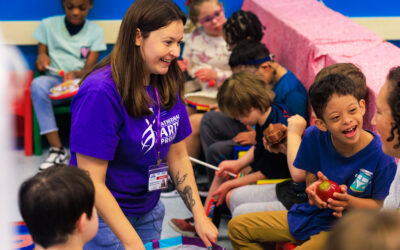
by CAP Teaching Artist Fellow Brittany Harmon, M.M., MT-BC, Board Certified Music Therapist
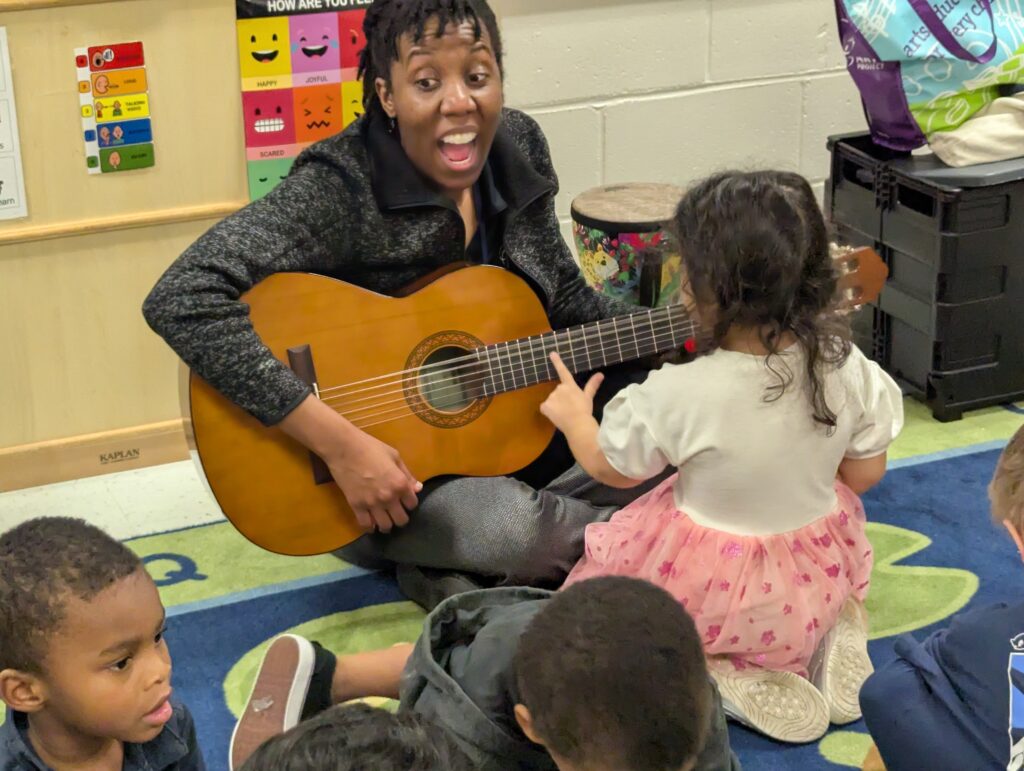
Brittany working with some of her students at Greenland Pines Elementary
It’s not uncommon for students—or staff, for that matter—to see me walking down the hallway with my Mary Poppins bag full of percussion instruments, a guitar strapped to my back, and a rolling cart stocked with sanitizing wipes (because yes, kids carry lots of germs). When they see me coming, they often call out, “Here comes the music teacher!”
I just smile and shake it off, because as a board-certified music therapist, I do provide music-based experiences. But their comment also tells me something important: many people don’t recognize the differences between music education and music therapy.
Music Therapy vs. Music Education: Some Common Misconceptions
- Misconception: Music therapy is the same as music class.
Truth: Music education classes focus on learning musical skills (like reading music, technique, and performance preparation), while music therapy uses music as a tool to support emotional, social, cognitive, and physical goals.
- Misconception: Music therapists are just music teachers with extra training.
Truth: Music therapists are board-certified healthcare professionals trained in psychology, child development, and clinical techniques, in addition to music.
- Misconception: If I don’t play an instrument or sing, I won’t benefit from music therapy.
Truth: You don’t need to “know” music to benefit. Music therapy might include drumming, movement, songwriting, listening, or improvising – all adapted to meet the child’s needs and abilities.
Why? Because music therapy goes beyond performance or having fun—it’s about connection and growth.
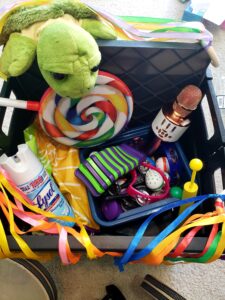
A glimpse inside a music therapist’s toolkit
Similar Tools, Different Goals
While music is the common thread, music therapy and music education differ in what’s being evaluated (i.e. goals) and how to measure progress. Let’s compare how success is measured.
Evaluating Success: Performance vs. Progress
Here’s how progress looks in both settings:
| Setting | Goal | Measurement |
| Music Education | Learn music skills and perform accurately | Tests, performances, or skill rubrics |
| Music Therapy | Support emotional or developmental growth | Increased communication, coping, engagement |
In short:
Music education teaches music.
Music therapy uses music to support overall health and development.
So, what does Taylor Swift have to do with this?
A lot, actually. The same Taylor Swift song can look totally different depending on who’s using it and why. Let’s break it down:
Music Education Using Taylor Swift’s “Shake It Off”:
A music teacher might:
- Break down the structure of the song (verse, pre-chorus, chorus).
- Teach students about dynamics, tempo and rhythm.
- Discuss lyrical meaning or artist influence, noting how Taylor Swift’s writing reflects personal experiences.
The main focus is on developing musical literacy and proficiency.
Music Therapy Using the Same Song:
A music therapist might:
- Use the lyrics to identify and express emotions and build empathy.
- Guide students in activities that involve turn-taking, like switching instruments or dance moves on the chorus to encourage social interaction and sustained attention.
- Ask students to reflect on how they cope with feelings like those expressed in the song.
In this setting, music becomes a tool, not a subject.
A Favorite Intervention: “Shake It Off” Lyric Replacement
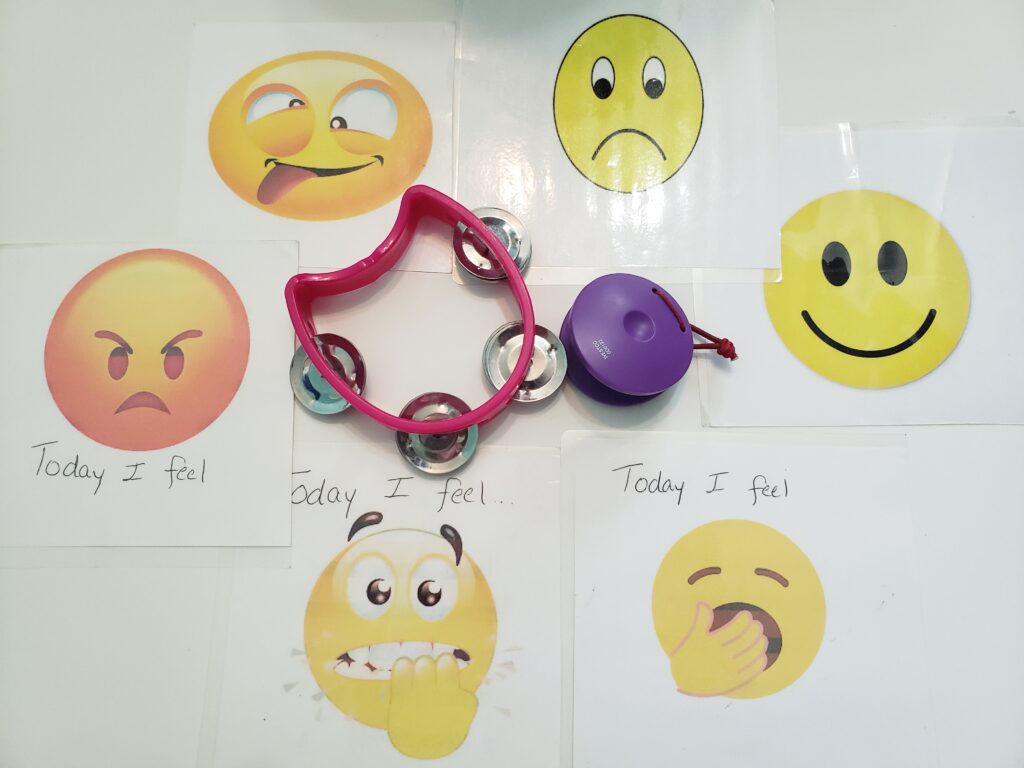
One of my favorite interventions for increasing emotional expression and social skills is songwriting. Try this one:
Therapeutic Lyric Replacement (to the tune of “Shake It Off”):
This encourages kids (and adults!) to express feelings and identify coping skills.
Instructions: Think of a challenging situation, something that made you feel upset, nervous, or embarrassed, and what you started doing or stopped doing to help you cope. Now fill in the blank spaces!
- I _______________________________ too ______________________________
- Got ______________________________ in my brain
- I _________________________ too many _____________________________
- But I can’t ________________________________________________
- But I keep _______________________________
- Can’t stop, won’t stop _____________________________
- Sayin’, ” _______________________________________________”
For nonverbal children, you can use picture cards or Augmentative and Alternative Communication (AAC) devices to fill in the blank spaces. Even practicing a single vocal sound, like the long “a” sound (as in “play,” “hate” and “shake” during the chorus) can be a meaningful communication-related goal if it’s on their IEP.
Music Therapy and Music Education: Can My Child Benefit from Both?
Absolutely! These two services are not mutually exclusive. In fact, many children thrive when they have access to both.
Ask yourself:
- Does my child enjoy music and want to improve musically? → Try music education.
- Does my child struggle with emotions, social skills, or behavior—and respond well to music? → Music therapy may be beneficial.
Both settings offer rich opportunities for growth in confidence, attention, communication and well-being. And both can start with a simple Taylor Swift song.
This article is part of a series of articles featuring CAP Teaching Artist Fellows, sharing monthly insights from their years of experience in arts education, personal stories that impacted their careers as artists and educators, and ideas for families to incorporate more creativity into their everyday lives. In August, we’ll hear from Chelsye P. Ginn, CAP Teaching Artist Fellow in Theatre.
To be notified when the next story is live, sign up for our email list today.