Every now and then, we get an idea in our head and no matter the evidence to the contrary, we won’t change our mind. We’re like those who refused to look through Galileo’s telescope because they didn’t want to see something that conflicted with their worldview.
Too many operate from the perspective that while the arts are important, they are not quite as important as math, science and other subjects. Some even distinguish the arts from academics, as though the arts are but a structured form of recess.
The prevailing perception is that the arts are “less than” other subjects, but in reality, what ends up being “less than” are our children, our schools, our workplaces and our society when we don’t treat the arts as the most important part of a well-rounded education.
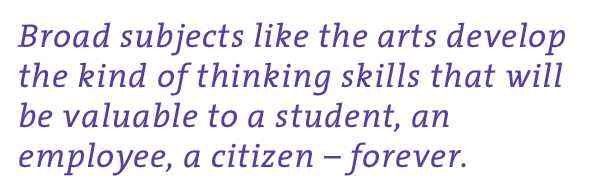
Today, narrow career and technical skills are taught at exactly the time we need broad subjects like the arts. These narrow subjects will be obsolete in a decade, if not before. But broad subjects like the arts develop the kind of thinking skills that will be valuable to a student, an employee, a citizen — forever.
This false dichotomy between academics and the arts places unnecessary limitations on our children’s curriculum and consequently, on their futures. Narrow subjects are preparing kids for narrow lives. Is that what we really want for our children?
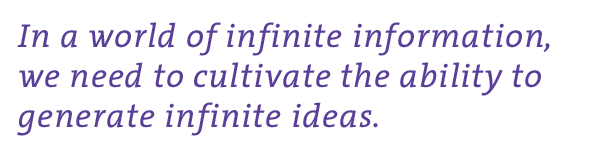
We need to teach kids big ideas if we want them to lead big lives. That’s why I am so grateful for Duval County Public Schools Superintendent Dr. Diana Greene and our school board for recommending funding for the arts be maintained at last year’s level, even in the face of a challenging budget. They understand it makes no sense to cut the most important part of the curriculum. In a world of infinite information, we need to cultivate the ability to generate infinite ideas.
Until we give the arts their rightful place and the esteem due them, we are compromising our kids’ futures. The arts cannot be treated as extracurricular time at the elementary level or as electives at the middle and high school levels. High school graduation and college admission requirements need to require as much from the arts as they do from the sciences. Life sure does.