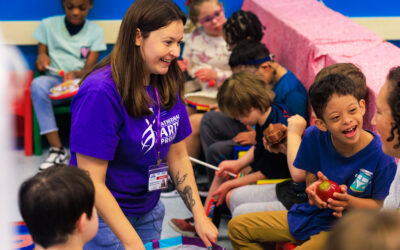
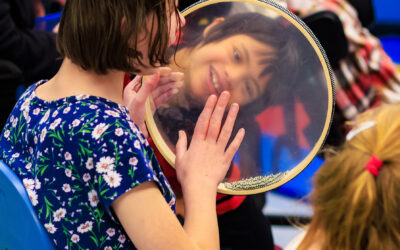
As 129,000 Duval County Public Schools students embark upon a new school year, laments about the poor quality of public education ring out as familiar as ever. Despite business interests and others funding countless reform efforts since the 1983 publication of “A Nation at Risk,”[i] the gap between educational outcomes of children from lower- and higher-income families, by many measures, has widened across the country.
A glimmer of hope appears in recent research out of Northwestern University that examines the larger school districts in Florida. The results present reason to trust that demographics are not destiny. Why? Because individual schools within Florida’s districts vary dramatically at closing the achievement gap.[ii] It’s not easy, but it’s possible.
One way to help students from all socioeconomic backgrounds learn is to treat them like the creative thinkers they are. In the midst of political polarization around education reform, there should be easy consensus that integrating the arts when learning other subjects works wonders and is cost-effective.
In arts integration, students connect an art form with another subject area and learn both. It’s not simply playing background music or doing a craft project. It’s about treating music, dance, theatre, media arts and visual arts as inherently valuable and then integrating these disciplines when learning science, math and other subjects.
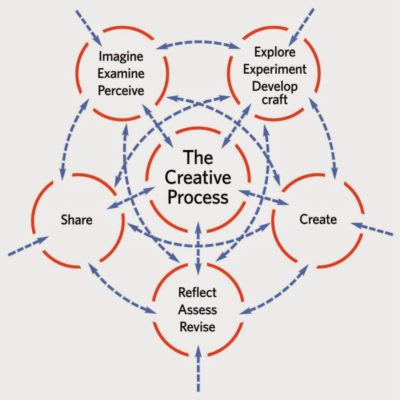
Illustration courtesy of the John F. Kennedy Center for the Performing Arts
Maya Angelou is often quoted for saying, “Do the best you can until you know better. Then when you know better, do better.” Well, we know better – yet we continue to teach children as if we don’t understand how they learn. Whatever the reason for this, it’s surely not because arts integration is too expensive or too experimental.
Turnaround Arts is a federal initiative to integrate arts learning into some of the nation’s lowest performing schools. In its first three years, Turnaround Arts demonstrated a 13 percent improvement in reading scores and a whopping 23 percent improvement in math scores.[iii]
Closer to home, the Cathedral Arts Project offers a theatre and civics integration program for middle schoolers. In end-of-course exams, 100 percent of students in the integration program were proficient, compared to only 46 percent and 78 percent in the control groups for 2014-2015 and 2015-2016, respectively. This is the remarkable difference arts integration can make – whether it’s in civics, math, science or language arts.
With arts integration, learning is not about students passively receiving information. It’s about what happens in their minds as they interact with information and with one another to solve problems. It’s about connecting the dots, applying knowledge from one subject to another and discovering innovative solutions. You know, the kind of work they’ll be called upon to do the rest of their lives.
Employers routinely report difficulty finding job candidates skilled at problem solving and innovative thinking. To the extent workforce development is one of the goals of education, wouldn’t it make sense to help students develop these skills? We can’t expect individuals to magically know how to analyze a problem from different perspectives just because they start to draw a paycheck. These habits of mind must be taught from the earliest years and throughout their education.
Regurgitating information no longer predicts success. In a world of infinite data anyone can retrieve from a phone, memorizing is not the way to demonstrate intelligence. What we need is what we have always needed – individuals who use their minds to think analytically as they tenaciously engage with a problem. To persevere in problem solving, one must be self-motivated and engaged, and there is nothing that engages our brains like the arts.[iv]
That’s one reason arts integration is a perfect way to address the achievement gap. The arts help children – all children – love school. Low-income students who are highly engaged in the arts are twice as likely to actually graduate from college as their peers with little or no arts education.[v]
Granted, integration must be done right. The greatest academic improvement occurs when students are engaged in integrated learning over successive years. Teachers need effective training, autonomy and support from principals. Arts teachers need principals who demonstrate by word and deed that the arts will not take a back seat at their school. And it must be research based.
Any Given Child Jacksonville and the Cultural Council of Greater Jacksonville are working with DCPS to implement arts integration in four schools. Through the support of PNC Bank and David Engdahl, the Lift Every Student program is embedding a local artist in each of these schools: Lucy Chen at John Love Early Learning Center, Valarie Esguerra at Hyde Park Elementary School, Sarah Crooks at Hyde Grove Early Learning Center, and Erin Kendrick at Smart Pope Livingston Elementary School. These artists in residence will work with classroom teachers to integrate the arts into other subjects so that students will get to experience and work with information rather than passively receive it. And when kids experience knowledge, it takes hold in their minds – minds that were created with the capacity to astound.
When all is said and done, there are only a few things we need to get right in life – educating children is one of those things.
Arts integration is a proven and cost-effective strategy on which people on both sides of the aisle should agree. It’s an area ripe for public-private partnerships. We’ve tried one reform effort after another and still have a crisis in education. It’s time we turn to the arts.
[i] United States. National Commission on Excellence in Education. Department of Education. A Nation at Risk: The Imperative for Educational Reform: A Report to the Nation and the Secretary of Education, United States Department of Education. Washington, D.C.: The Commission: [Supt. of Docs., U.S. G.P.O. distributor], 1983.
[ii] Some schools much better than others at closing achievement gaps between their advantaged and disadvantaged students. David Figlio and Krzysztof Karbownik. Evidence Speaks Reports, Vol 2, #19 July 20, 2017. Center on Children and Families. Brookings Institution.
[iii] Turnaround Arts Initiative: Summary of Key Findings
[iv]An Impact Evaluation of Arts-Integrated Instruction Through the Changing Education Through the Arts (CETA) Program, The Kennedy Center, 2014.
[v] Americans for the Arts, 2015.