by Lindsay Bowyer, Teaching Artist Fellow in Visual Arts
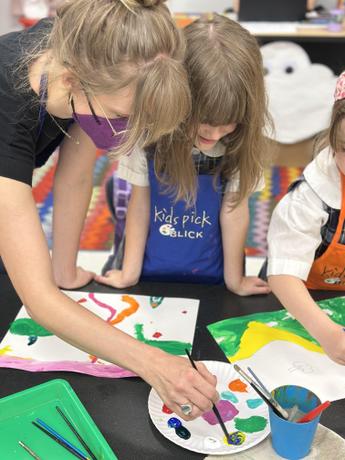
Lindsay introduced her students at Jacksonville Classical Academy to artist David Hockney and discussed his landscape works featuring unique perspectives, bright colors and patterns.
October is National Arts & Humanities Month, the nation’s largest annual celebration of arts and culture. It’s a good time to reflect on what I think is the most important component of the arts: their inherent connection to our sense of humanity, self, history and place.
I worked for several years as a museum educator, and in my work not everyone I encountered was interested in art, especially the modern and contemporary pieces that were on display. But one of my favorite points to make to visitors was that art is one of the most (if not the most) human activities in existence, predating written texts.
Before humans constructed alphabets, they were creating and teaching each other stories, music and images. Some such images, like the cave paintings of Lascaux, seem to exist for no discernible or practical purpose, though theories abound. Some ancient images were symbols of cultural significance, some were grave markers, others gave form to gods and cosmologies—all with the same fundamental goal: to create a visual representation of immaterial ideas and concepts.
The status of the arts and humanities across history and cultures is just as challenging to pin down: simultaneously vehicles of ornamentation, status, style, storytelling, learning, expression, politics, social commentary and economy. There are countless styles, materials and motifs across visual arts, music and literature, yet a handful of symbols and archetypes persist, speaking to humanity’s shared experiences: the open hand, the spiral, the whirligig figure, sacred and infernal chords, heroes and tricksters.
This may sound a bit lofty for someone who works primarily with elementary school children. But the universal connection to the arts, creativity and expression speaks to their intrinsic educational and socio-emotional value; I don’t have to prompt my students with a lesson on cave paintings for some of them to trace their own hands.

Cave art at Carnarvon National Park, Nandowrie QLD, Australia | Photo by Athithan Vignakaran
Data collected by the National Center for Educational Statistics in 2024 shows that participating in arts activities—from singing songs to reading to painting—yields significant social and academic benefits from preschool to high school, including better attendance, pro-social behaviors and higher testing scores. This information validates a belief that has existed since ancient Greece: that a well-rounded education makes for citizens who are better prepared to participate in society.
Despite such supportive data, there is a persistent idea that fields of study not clearly linked to a specialized profession and/or profit lack value, and that those who engage in said fields are bereft of “real” skills. I encountered this mentality many times when I was a student, and I sadly continue to witness it in some of my students today. Rarely (if ever) was I asked what I enjoyed about studying art, what challenges I encountered or what research I was completing; the question I fielded most often was some variation of “so what are you going to do with that?” This mentality seems to run parallel to an opposing school of thought: that the arts are only for highly skilled people to practice and therefore inaccessible to most of society.
I don’t work with adults often, but when I do I’m always a little saddened to hear how often they reject the chance to be creative without even trying. I often hear replies like “I’m not artistic at all, I can’t even draw a stick figure,” or “Mine will be ugly” or “I’ll just ruin it.”
I encourage everyone, but especially parents, to investigate these responses and challenge them accordingly: Does art have to be “good” for us to enjoy making it? Who decides it’s good? Why does it have to be good?
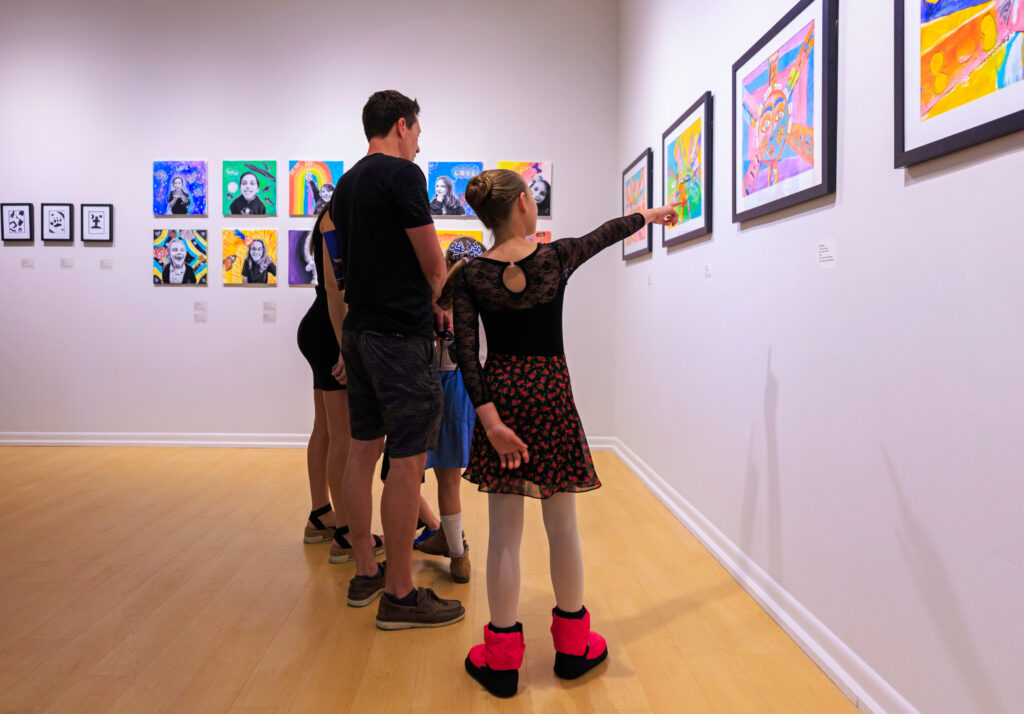
Students and families admire artwork together at the 2024 CAP Visual Arts Showcase | Photography by Toni Smailagic of Cre8Jax in Jacksonville, Florida
This mindset can be challenging to break out of, so here are some suggestions for humanities-driven activities that anyone of any skill level can enjoy:
-
- Practice investigating art with your child (or other adult friends!). Children are naturally curious and tend to respond well to opportunities to use their imagination. Look at art in person, in a book or in an online collection (many museums have their collections available online in whole or part) and practice some open-ended questions:
What do you like (or dislike) about this art?
What would you change about it?
How long do you think the artist took to make it?
What story do you think they are telling?
If your child is older, they will likely appreciate an earnest attempt to hear their opinion on something without judgement or correction. Be honest and open-minded, and don’t be concerned with answering correctly.
-
- Try making a seasonal craft together. This does not have to be expensive or complicated; I have very early memories of turning pine cones into Christmas trees with my mom using just paint and glitter. It was a great way to spend time together and we still have those pinecones!
- If you’re looking for something a little more skill-driven but still accessible, the internet is full of generous, creative teachers who share their lessons for free. Some even include videos, making it approachable for all learners. Try using search words that include your child’s grade level for curated results, such as “third grade landscape art project,” then work through the project together. When you’re both finished, talk about which parts were challenging and which came more easily.
- Choose some music you and your student will enjoy and add some dance moves to your chore time. This is another early memory for me—listening to my mom’s cassette tapes cranked up on the stereo, dancing and singing our way through dusting the house and sweeping the floors. I got to spend time with my mom and it made housework feel more fun rather than something to be avoided. This exercise also helps demonstrate that enjoying music and movement can happen at any time—it doesn’t have to be a formal performance or something we do perfectly!
- Nurture a love of theatre. This could be viewing anything from classics like The Sound of Music to more contemporary stage adaptations of movies like Finding Nemo or Shrek. Many of these are available for free on YouTube or via streaming services. A more personal activity that you can tailor to your student’s interests is reading to them in different voices for different characters, it’s like a private dramatic reading!
We live in a very outcome-driven society, where we are encouraged to monetize as much as possible; our skills, our hobbies, our “personal brands” are more often than not viewed through the lens of potential capital. And with the rise of AI, some are opting to outsource creativity and analysis entirely, often at the expense of artists and writers who have spent years honing their skillset.
These factors emphasize the need for arts and humanities in our lives more than ever—it’s about much more than raising test scores and encouraging critical thinking (although these are undoubtedly very valuable). They spark conversation, curiosity and connection with people across cultures, ages and time periods.
In short, the arts remind us of what it means to be human.
—
This story is part of a series of articles featuring CAP Teaching Artist Fellows. They’ll share monthly insights from their years of experience in arts education, personal stories that impacted their careers as artists and educators, and ideas for families to incorporate more creativity into their everyday lives.
In November, we’ll learn from Christian Anderson, Delores Barr Weaver Teaching Artist Fellow in Theatre. To be notified when the next story is live, sign up for our email list today.